
Choosing the right material for furniture or interiors can get confusing, especially when the terms start overlapping. One of the most common questions people ask is—engineered wood or MDF? But here’s the catch: MDF (Medium Density Fiberboard) is actually a type of engineered wood.
Still, in practical terms, people use “engineered wood” to mean a broader category (like HDF, particle board, HDHMR), and compare it specifically with MDF as a distinct option.
At first glance, both look similar—flat, smooth boards used in modern furniture. But once you go deeper, differences start to show in density, strength, moisture resistance, and long-term performance.
There is no single “better” option here. Some people prefer MDF for its smooth finish and affordability. Others go for higher-grade engineered boards for better strength and durability.
So instead of guessing, let’s break this down clearly. By the end, you’ll know exactly what suits your needs—not just what sounds technical.
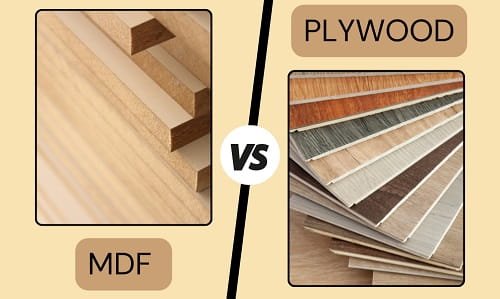
Quick Comparison
| Feature | Engineered Wood (HDF/HDHMR/Particle Board) | MDF (Medium Density Fiberboard) |
| Material | Wood fibers, chips, or layers | Fine wood fibers |
| Density | Varies (low to very high) | Medium density |
| Strength | Low to high (depends on type) | Moderate |
| Surface Finish | Smooth (varies by type) | Very smooth |
| Moisture Resistance | Moderate to high (HDHMR best) | Low to moderate |
| Cost | Low to moderate | Moderate |
| Durability | Varies (HDHMR high) | Moderate |
| Workability | Easy (depends on type) | Very easy |
1. Material and Structure: The Core Difference
This is where everything begins.
Engineered wood is a broad category. It includes materials like particle board, MDF, HDF, and HDHMR. These are made by compressing wood fibers, chips, or veneers with adhesives under pressure.
MDF is a specific type of engineered wood made from very fine wood fibers. These fibers are tightly compressed to create a smooth and uniform board.
Simple takeaway:
- Broad category with multiple types → Engineered wood
- Specific, fiber-based board → MDF
2. Strength and Durability
This depends heavily on the type of engineered wood.
Higher-grade engineered wood like HDF or HDHMR can be quite strong and durable. These are used in better-quality furniture and interiors.
MDF offers moderate strength. It is stronger than particle board but weaker than high-density boards. It works well for general furniture but not for heavy loads.
Simple takeaway:
- Varies from low to high strength → Engineered wood
- Consistent, moderate strength → MDF
3. Moisture and Water Resistance
This is one of the most important differences.
Standard MDF is sensitive to moisture. It can swell or get damaged if exposed to water. Moisture-resistant MDF exists, but it still needs protection.
Engineered wood offers more variety here. Boards like HDHMR are designed to resist moisture better than MDF.
Simple takeaway:
- Better moisture options available → Engineered wood
- Sensitive to water → MDF
4. Surface Finish and Appearance
This is where MDF clearly shines.
MDF has a very smooth and uniform surface. It is perfect for painting, polishing, and laminates. That’s why it is widely used in modular furniture.
Engineered wood can also have smooth surfaces, but it depends on the type. Particle board is rougher, while HDF is smoother.
Simple takeaway:
- Best for smooth finish → MDF
- Depends on type → Engineered wood
5. Cost and Affordability
Both are budget-friendly compared to solid wood—but there are differences.
MDF is moderately priced and offers a good balance between cost and quality.
Engineered wood ranges from very cheap (particle board) to moderately expensive (HDHMR).
Simple takeaway:
- Consistent mid-range pricing → MDF
- Wide price range → Engineered wood
6. Workability and Design Flexibility
MDF is very easy to work with.
It can be cut, shaped, and designed easily. It is ideal for detailed designs, CNC cutting, and modern furniture.
Engineered wood is also workable, but it varies. Particle board can chip easily, while HDHMR is stronger but harder to cut.
Simple takeaway:
- Best for detailed design work → MDF
- Varies by type → Engineered wood
7. Weight and Handling
MDF is dense and slightly heavy compared to particle board.
Engineered wood varies—particle board is lighter, while HDF and HDHMR are heavier.
Simple takeaway:
- Moderate weight → MDF
- Varies (light to heavy) → Engineered wood
8. Lifespan and Long-Term Value
Engineered wood offers better options for long-term use—if you choose the right type.
High-density boards like HDHMR last longer and handle wear better.
MDF has a moderate lifespan. It works well for interiors but may not last as long under heavy use or moisture exposure.
Simple takeaway:
- Better long-term options available → Engineered wood
- Moderate lifespan → MDF
9. Best Use Cases
MDF is ideal for:
- Modular furniture
- Painted furniture
- Decorative panels
- Interior designs
Engineered wood is ideal for:
- Budget furniture (particle board)
- Durable interiors (HDHMR/HDF)
- Cabinets and wardrobes
- Office furniture
Simple takeaway:
- Design and finish → MDF
- Range of uses depending on type → Engineered wood
Final Verdict: Which One Should You Choose?
There’s no single winner—and that’s exactly how it should be.
Pros of Engineered Wood:
- Wide range of options (budget to premium)
- Better moisture-resistant choices available
- Can be stronger than MDF (in high-grade types)
- Suitable for different applications
Cons of Engineered Wood:
- Quality varies widely
- Lower-grade boards can be weak
- Surface finish depends on type
Pros of MDF:
- Very smooth surface
- Great for painting and laminates
- Easy to cut and design
- Consistent quality
Cons of MDF:
- Sensitive to moisture
- Moderate strength only
- Not ideal for heavy loads
- Shorter lifespan than high-grade boards
Final Choice
Choose MDF if:
- You want smooth, paint-ready surfaces
- You’re working on modular or decorative furniture
- You need easy workability
Choose engineered wood (like HDHMR/HDF) if:
- You want better durability and strength
- You need moisture resistance
- You’re working on long-term furniture
In the end, this choice is less about which material is “better” and more about which type of engineered wood you are actually choosing. MDF is great for finish and design. Other engineered boards can offer better strength and durability.
Pick based on your use—not just the name.