
Choosing between engineered wood and particle board can feel confusing—mainly because particle board itself is actually a type of engineered wood. But in real-world use, people usually compare higher-grade engineered wood (like MDF/HDF) with basic particle board.
At first glance, both look similar. Flat boards, used in furniture, often covered with laminate. But internally, they are quite different. One is made from fine wood fibers compressed tightly. The other is made from wood chips and sawdust bonded together.
That difference affects everything—strength, durability, finish, and long-term performance.
There is no single “better” option here. Some people choose engineered wood (like MDF) for smoother finish and better quality. Others go with particle board for affordability and simple use.
So instead of guessing, let’s break this down clearly. By the end, you’ll know exactly what suits your project.
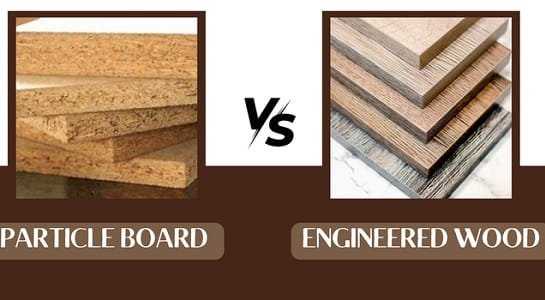
Top Products Comparison (Real Market Examples)
Interior Grade Plain MDF Board 12mm · ₹48
Smooth engineered wood board ideal for furniture and modular interiors.
Brown Laminated Particle Board 9–18mm · ₹31.86
Affordable chipboard panel widely used for budget furniture and interior work.
Product Comparison Table
| Attribute | MDF Board
₹48•plyduniya.com |
Particle Board
₹31.86•Tradeindia.com |
| Material | Wood fibers (fine) | Wood chips & sawdust |
| Strength | Medium to high | Low to medium |
| Surface Finish | Very smooth | Slightly rough |
| Moisture Resistance | Moderate (varies by grade) | Low |
| Cost | Moderate | Low |
| Durability | Better | Lower |
| Best Use | Modular furniture | Budget furniture |
1. Material and Structure: The Real Difference
This is where everything starts.
Engineered wood (like MDF or HDF) is made by compressing fine wood fibers with resin under high pressure. This creates a dense and uniform board.
Particle board is made from wood chips, sawdust, and resin pressed together. It is less dense and more basic in structure.
Simple takeaway:
- Dense, refined structure → Engineered wood
- Basic chip-based structure → Particle board
2. Strength and Durability
This is where engineered wood clearly performs better.
MDF (a type of engineered wood) is denser and stronger than particle board, making it more suitable for furniture.
Particle board is weaker and can break or sag under heavy weight. It is considered the lowest strength among wood boards.
Simple takeaway:
- Better strength and durability → Engineered wood
- Basic strength → Particle board
3. Surface Finish and Appearance
This is where engineered wood shines.
Engineered wood boards have a smooth and uniform surface, ideal for paint, polish, and laminates.
Particle board has a rougher surface and usually needs lamination to look presentable.
Simple takeaway:
- Smooth, premium finish → Engineered wood
- Needs covering/laminate → Particle board
4. Moisture and Water Resistance
Neither is perfect—but engineered wood is better.
Engineered wood (especially HDF or HDHMR) offers better moisture resistance due to higher density.
Particle board is very sensitive to moisture. It can swell, weaken, or get damaged quickly if exposed to water.
Simple takeaway:
- Better moisture handling → Engineered wood
- Highly sensitive → Particle board
5. Cost and Affordability
This is where particle board wins easily.
Particle board is one of the cheapest materials used in furniture. It is often chosen when budget is the main concern.
Engineered wood costs more but offers better quality and performance.
Simple takeaway:
- Cheapest option → Particle board
- Better value for quality → Engineered wood
6. Weight and Workability
Both are easy to work with—but slightly different.
Engineered wood is dense and smooth, making it easy for precise cutting and shaping.
Particle board is lighter and easier to handle but can chip or break during cutting.
Simple takeaway:
- Precision work → Engineered wood
- Light and easy handling → Particle board
7. Lifespan and Long-Term Value
This is where engineered wood again stands ahead.
Engineered wood lasts longer and maintains its structure better over time.
Particle board has a shorter lifespan, especially in high-use areas or humid conditions.
Simple takeaway:
- Longer lifespan → Engineered wood
- Short-term use → Particle board
8. Best Use Cases
Engineered wood is ideal for:
- Modular furniture
- Wardrobes and cabinets
- Office furniture
- Interior panels
Particle board is best for:
- Budget furniture
- Temporary setups
- Lightweight items
Simple takeaway:
- Better for long-term furniture → Engineered wood
- Good for low-cost setups → Particle board
Final Verdict: Which One Should You Choose?
There’s no single winner—and that’s exactly how it should be.
Pros of Engineered Wood:
- Stronger and more durable
- Smooth surface for finishing
- Better moisture resistance
- Longer lifespan
Cons of Engineered Wood:
- More expensive than particle board
- Still not as strong as plywood
Pros of Particle Board:
- Very affordable
- Lightweight
- Easy to use for simple furniture
- Widely available
Cons of Particle Board:
- Weak strength
- Poor moisture resistance
- Short lifespan
- Can break or sag easily
Final Choice
Choose engineered wood if:
- You want better quality and durability
- You’re making modular furniture
- You need a smooth finish
Choose particle board if:
- You are on a tight budget
- You need temporary or low-use furniture
- Cost matters more than long-term performance
In the end, this choice is less about which material is “better” and more about what you expect from it. Engineered wood gives you better quality and finish. Particle board gives you affordability.