
Buying the right board material is one of those decisions that quietly decides everything—how strong your furniture feels, how long it lasts, and how much trouble you’ll face later. And today, one comparison is becoming more common than ever—HDHMR board or plywood?
At first glance, both look similar. Flat sheets. Used for furniture, cabinets, wardrobes. But internally, they are completely different materials. One is engineered using compressed wood fibers. The other is made by layering natural wood veneers.
This difference changes everything—strength, moisture resistance, cost, and even how the board behaves over time.
There is no one perfect choice here. Some people prefer the modern consistency of HDHMR boards. Others trust the long-proven strength of plywood. It all depends on your usage, budget, and expectations.
So instead of guessing, let’s break it down clearly. By the end, you’ll know exactly which one suits your work—not just what sounds modern.
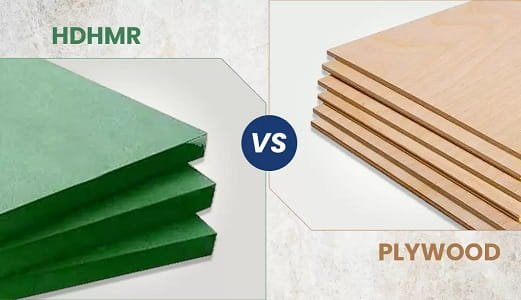
1. Material and Structure: The Core Difference
This is where the real difference begins.
HDHMR (High Density High Moisture Resistance) is an engineered board made by compressing wood fibers with resin under high pressure. It creates a dense, uniform sheet with no gaps or grains.
Plywood, on the other hand, is made by layering thin sheets of natural wood (veneers) glued together in cross directions. This gives it natural strength and flexibility.
Simple takeaway:
- Want uniform, engineered material → HDHMR
- Prefer natural wood structure → Plywood
2. Strength and Load Capacity
Both are strong—but in different ways.
HDHMR boards have very high density, which gives them good screw holding and stability.
Plywood, especially BWP or marine grade, is known for its exceptional strength and ability to handle heavy loads without bending.
Simple takeaway:
- Uniform strength and stability → HDHMR
- Heavy load and long-term strength → Plywood
3. Moisture and Water Resistance
This is one of the most important factors.
HDHMR is moisture-resistant, which means it can handle humidity and damp conditions quite well. But it is not fully waterproof and can swell if exposed to water for long periods.
Plywood (especially BWP/marine grade) is highly water-resistant and can handle even extreme conditions like kitchens and bathrooms.
Simple takeaway:
- Good for moisture → HDHMR
- Best for water exposure → Plywood
4. Surface Finish and Appearance
This is where HDHMR shines.
HDHMR boards come with a very smooth and uniform surface. They are ideal for laminates, paints, and modern modular furniture.
Plywood surfaces are slightly uneven and usually need additional finishing like laminate or veneer.
Simple takeaway:
- Smooth ready surface → HDHMR
- Raw surface needing finish → Plywood
5. Cost and Budget
HDHMR boards are generally affordable for what they offer. They give a modern engineered option at a reasonable price.
Plywood can be cheaper in lower grades but becomes expensive in premium grades like BWP or marine.
Simple takeaway:
- Budget-friendly modern option → HDHMR
- Price varies widely → Plywood
6. Durability and Lifespan
Plywood has a long track record. It has been used for decades and is known to last for years without major issues.
HDHMR is newer but performs well due to its density and resistance to termites and borers. However, improper exposure to water can reduce its life.
Simple takeaway:
- Proven long-term durability → Plywood
- Modern durability with limits → HDHMR
7. Best Use Cases
HDHMR boards are ideal for:
- Modular furniture
- Wardrobes and cabinets
- Interior panels
Plywood is best for:
- Kitchens and bathrooms
- Heavy furniture
- Structural work
Simple takeaway:
- Modern interiors → HDHMR
- Heavy-duty and wet areas → Plywood
Final Verdict: Which One Should You Choose?
There’s no single winner—and that’s exactly how it should be.
Choose HDHMR board if:
- You want a smooth, modern finish
- You need moisture resistance (not direct water exposure)
- You prefer a cost-effective engineered option
Choose plywood if:
- You want maximum strength and long life
- You need water resistance (kitchen, bathroom)
- You trust traditional, proven material
In the end, this choice is less about which board is “better” and more about where you are going to use it. Some materials look better on paper. Others perform better in real life.
Pick based on your usage—not just the trend.