
Choosing the right material for furniture or interiors is not always as simple as it looks. What you pick today will decide how your cabinets hold up, how your wardrobes feel after a few years, and how much maintenance you’ll deal with. And one comparison that often confuses people is—engineered wood or plywood?
At first glance, both seem similar. Flat boards, used in furniture, available in different thicknesses. But the reality is very different. One is a broad category of manufactured boards like MDF, HDF, and particle board. The other is a specific type of layered wood product known for strength.
This difference changes everything—durability, cost, moisture resistance, and long-term performance.
There is no single “better” option here. Some people prefer engineered wood for its smooth finish and affordability. Others trust plywood for its strength and reliability.
So instead of guessing, let’s break this down properly. By the end, you’ll know which one fits your needs—not just what sounds modern.
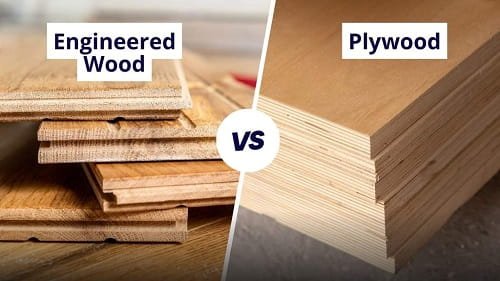
1. Material and Structure: The Core Difference
This is where everything begins.
Engineered wood is made by compressing wood fibers, chips, or particles using adhesives and pressure. It includes materials like MDF (Medium Density Fiberboard), HDF, and particle board. These boards are uniform, smooth, and easy to shape.
Plywood is made by gluing together thin layers of natural wood (veneers) in cross directions. This layered construction gives it strength and flexibility.
Simple takeaway:
- Manufactured, uniform boards → Engineered wood
- Layered natural wood structure → Plywood
2. Strength and Durability
This is where plywood clearly stands ahead.
Plywood is strong and durable. Its cross-layered design distributes weight evenly, making it suitable for heavy furniture and long-term use.
Engineered wood varies in strength depending on the type. MDF and particle board are not as strong as plywood and may weaken under heavy load.
Simple takeaway:
- High strength and durability → Plywood
- Moderate strength (depends on type) → Engineered wood
3. Moisture and Water Resistance
This is one of the biggest deciding factors.
Plywood, especially BWR or BWP (marine grade), offers strong resistance to water and moisture. It performs well in kitchens, bathrooms, and humid conditions.
Engineered wood is more sensitive to moisture. MDF and particle boards can swell or get damaged if exposed to water.
Simple takeaway:
- Better moisture resistance → Plywood
- Sensitive to water → Engineered wood
4. Surface Finish and Appearance
This is where engineered wood shines.
Engineered wood boards have a smooth and uniform surface. They are ideal for laminates, paints, and modern finishes. This makes them popular for modular furniture.
Plywood surfaces are slightly uneven and usually require finishing like laminate or veneer.
Simple takeaway:
- Smooth and ready surface → Engineered wood
- Needs finishing → Plywood
5. Cost and Affordability
Engineered wood is more budget-friendly.
It offers a cost-effective solution for furniture and interiors, especially for large projects.
Plywood is more expensive, especially in higher grades. But the price comes with better strength and durability.
Simple takeaway:
- Affordable option → Engineered wood
- Higher cost but better value → Plywood
6. Weight and Workability
Engineered wood is easier to work with.
It is lighter and easier to cut, shape, and design. This makes it suitable for modern furniture manufacturing.
Plywood is heavier and slightly harder to handle but offers better structural stability.
Simple takeaway:
- Easy to cut and design → Engineered wood
- Strong but heavier → Plywood
7. Lifespan and Long-Term Value
Plywood has a longer lifespan.
It can last for many years without major issues if maintained properly. It also handles wear and tear better.
Engineered wood has a shorter lifespan, especially in high-usage areas. Over time, it may weaken or lose strength.
Simple takeaway:
- Long-term durability → Plywood
- Short to medium lifespan → Engineered wood
8. Best Use Cases
Engineered wood is ideal for:
- Modular furniture
- Wardrobes and cabinets
- Interior panels
- Budget projects
Plywood is best for:
- Kitchens and bathrooms
- Heavy furniture
- Structural work
- Long-term investment furniture
Simple takeaway:
- Modern interiors → Engineered wood
- Strong, heavy-duty use → Plywood
Final Verdict: Which One Should You Choose?
There’s no single winner—and that’s exactly how it should be.
Pros of Engineered Wood:
- Affordable and budget-friendly
- Smooth and uniform surface
- Easy to work with
- Ideal for modern designs
Cons of Engineered Wood:
- Less durable
- Sensitive to moisture
- Shorter lifespan
- Not suitable for heavy loads
Pros of Plywood:
- Strong and durable
- Better water resistance
- Long-lasting performance
- Suitable for heavy furniture
Cons of Plywood:
- More expensive
- Heavier
- Needs finishing for better appearance
Choose engineered wood if:
- You want a budget-friendly solution
- You’re working on modular furniture
- You prefer smooth finishes and modern designs
Choose plywood if:
- You want strength and long-term durability
- You’re building kitchen or heavy-use furniture
- You want a reliable material that lasts for years
In the end, this choice is less about which material is “better” and more about how you plan to use it. Some materials are designed for looks and cost efficiency. Others are built for strength and longevity.