
Choosing tiles is one of those decisions that quietly defines your entire home. It affects how your floor looks, how it feels under your feet, and how well it holds up over years of use. And when it comes to modern flooring, one confusion shows up again and again—porcelain tiles or vitrified tiles?
At first glance, both look almost the same. Smooth finish, modern designs, glossy or matte options. Many people even think they are the same thing. But once you go deeper, you realize there are real differences—especially in strength, water resistance, cost, and usage.
Both are excellent choices. Both are widely used in Indian homes. But they are designed for slightly different purposes.
So instead of guessing, let’s break this down properly. By the end, you’ll know which one fits your home—not just what looks good in the showroom.
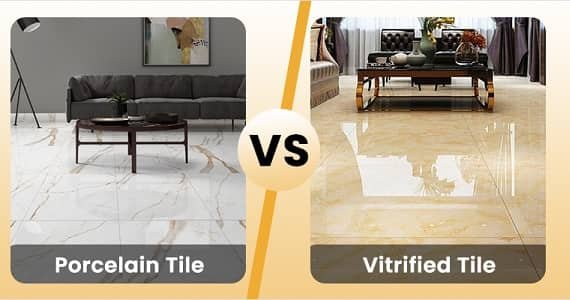
1. Material and Manufacturing: The Core Difference
This is where everything starts.
Porcelain tiles are made using refined clay and fired at extremely high temperatures. This makes them very dense and almost non-porous.
Vitrified tiles are also ceramic-based but made by mixing clay with silica and quartz, then compressed and heated to create a glass-like surface.
Because of this, porcelain is usually denser than vitrified tiles.
Simple takeaway:
- Higher density and finer material → Porcelain tiles
- Glass-like finish with mixed materials → Vitrified tiles
2. Strength and Durability
This is where porcelain takes a slight lead.
Porcelain tiles are extremely hard and durable due to high-temperature firing. They are more resistant to wear, scratches, and heavy use.
Vitrified tiles are also strong and can handle heavy foot traffic, especially in homes and commercial spaces, but they are slightly less dense compared to porcelain.
Simple takeaway:
- Maximum durability → Porcelain tiles
- Strong but slightly less dense → Vitrified tiles
3. Water Absorption and Moisture Resistance
This is one of the biggest differences.
Porcelain tiles have extremely low water absorption (below 0.5%), making them highly resistant to moisture.
Vitrified tiles also have low water absorption (below 1%), but porcelain still has a slight edge.
Simple takeaway:
- Best for water resistance → Porcelain tiles
- Very good but slightly lower → Vitrified tiles
4. Appearance and Finish
Both tiles offer excellent designs—but with a different feel.
Porcelain tiles often come in matte, textured, or natural stone-like finishes. They give a premium, subtle look.
Vitrified tiles are popular for their glossy, polished finish. They create a shiny, modern appearance and reflect light well.
Simple takeaway:
- Natural, premium textures → Porcelain tiles
- Glossy, shiny finish → Vitrified tiles
5. Cost and Budget
This is where most decisions get made.
Porcelain tiles are usually more expensive due to their density, strength, and advanced manufacturing process.
Vitrified tiles are more affordable and offer good value for money, especially for large areas like living rooms or entire homes.
Simple takeaway:
- Premium pricing → Porcelain tiles
- Budget-friendly → Vitrified tiles
6. Maintenance and Cleaning
Both tiles are low maintenance—but vitrified has a slight advantage.
Vitrified tiles are easy to clean and maintain due to their smooth, glass-like surface.
Porcelain tiles are also easy to maintain, but textured or matte finishes may require slightly more cleaning effort.
Simple takeaway:
- Easier maintenance → Vitrified tiles
- Low maintenance overall → Porcelain tiles
7. Usage and Best Applications
This is where the real decision becomes clear.
Porcelain tiles are ideal for:
- Bathrooms and kitchens
- Outdoor areas
- High-traffic zones
- Areas exposed to water and weather
Vitrified tiles are ideal for:
- Living rooms
- Bedrooms
- Offices and commercial spaces
- Large indoor flooring areas
Porcelain performs better in extreme conditions, while vitrified is perfect for general use.
Simple takeaway:
- Tough conditions and outdoors → Porcelain tiles
- Indoor flooring → Vitrified tiles
Final Verdict: Which One Should You Choose?
There’s no single winner—and that’s exactly how it should be.
Pros of Porcelain Tiles:
- Extremely durable and hard
- Best water resistance
- Suitable for outdoor and wet areas
- Premium look and finish
Cons of Porcelain Tiles:
- Expensive
- Harder to cut and install
- Slightly heavier
Pros of Vitrified Tiles:
- Affordable and cost-effective
- Smooth, glossy finish
- Easy to maintain
- Suitable for large indoor areas
Cons of Vitrified Tiles:
- Slightly less dense than porcelain
- Not as strong for extreme conditions
- Glossy surface can be slippery
Choose porcelain tiles if:
- You want maximum durability
- You need tiles for bathrooms, kitchens, or outdoors
- You’re ready to invest more for long-term performance
Choose vitrified tiles if:
- You want a budget-friendly option
- You need tiles for living rooms or bedrooms
- You prefer a glossy, modern finish
In the end, this choice is less about which tile is “better” and more about where you’re going to use it. Some tiles are built for tough conditions. Others are designed for comfort and appearance.